<?xml version="1.0" encoding="utf-8"?>
<feed xmlns="http://www.w3.org/2005/Atom">
    <title>Neal Haslem - Design Research</title>
    <link rel="alternate" type="text/html" href="http://www.nealhaslem.net/" />
    <link rel="self" type="application/atom+xml" href="http://www.nealhaslem.net/atom.xml" />
   <id>tag:www.nealhaslem.net,2012://9</id>
    <link rel="service.post" type="application/atom+xml" href="http://www.decomm.net/movabletype/mt-atom.cgi/weblog/blog_id=9" title="Neal Haslem - Design Research" />
    <updated>2012-07-26T02:05:53Z</updated>
    <subtitle>Communication design and the other: a socially-situated practice
design is materialising our future selves  keywords: design and the other / bringing-into-being / transformative activity / relational design / radical design / what communication designers do / communication design as conversation / communication design as materialising knowledge / practice-led design research</subtitle>
    <generator uri="http://www.sixapart.com/movabletype/">Movable Type 3.2</generator>
 
<entry>
    <title>test</title>
    <link rel="alternate" type="text/html" href="http://www.nealhaslem.net/archives/2012/07/test.html" />
    <link rel="service.edit" type="application/atom+xml" href="http://www.decomm.net/movabletype/mt-atom.cgi/weblog/blog_id=9/entry_id=875" title="test" />
    <id>tag:www.nealhaslem.net,2012://9.875</id>
    
    <published>2012-07-26T02:05:42Z</published>
    <updated>2012-07-26T02:05:53Z</updated>
    
    <summary>tester...</summary>
    <author>
        <name>Neal Haslem</name>
        
    </author>
    
    <content type="html" xml:lang="en" xml:base="http://www.nealhaslem.net/">
        <![CDATA[<p>tester</p>]]>
        
    </content>
</entry>
<entry>
    <title>a new test</title>
    <link rel="alternate" type="text/html" href="http://www.nealhaslem.net/archives/2012/07/a_new_test.html" />
    <link rel="service.edit" type="application/atom+xml" href="http://www.decomm.net/movabletype/mt-atom.cgi/weblog/blog_id=9/entry_id=874" title="a new test" />
    <id>tag:www.nealhaslem.net,2012://9.874</id>
    
    <published>2012-07-26T02:01:17Z</published>
    <updated>2012-07-26T02:01:36Z</updated>
    
    <summary>tester...</summary>
    <author>
        <name>Neal Haslem</name>
        
    </author>
    
    <content type="html" xml:lang="en" xml:base="http://www.nealhaslem.net/">
        <![CDATA[<p>tester</p>]]>
        
    </content>
</entry>
<entry>
    <title>tester</title>
    <link rel="alternate" type="text/html" href="http://www.nealhaslem.net/archives/2010/06/tester.html" />
    <link rel="service.edit" type="application/atom+xml" href="http://www.decomm.net/movabletype/mt-atom.cgi/weblog/blog_id=9/entry_id=871" title="tester" />
    <id>tag:www.nealhaslem.net,2010://9.871</id>
    
    <published>2010-06-12T03:21:12Z</published>
    <updated>2010-06-12T03:22:10Z</updated>
    
    <summary>test...</summary>
    <author>
        <name>Neal Haslem</name>
        
    </author>
    
    <content type="html" xml:lang="en" xml:base="http://www.nealhaslem.net/">
        <![CDATA[<p>test</p>]]>
        
    </content>
</entry>
<entry>
    <title>the role of the designer...</title>
    <link rel="alternate" type="text/html" href="http://www.nealhaslem.net/archives/2008/06/the_role_of_the_designer.html" />
    <link rel="service.edit" type="application/atom+xml" href="http://www.decomm.net/movabletype/mt-atom.cgi/weblog/blog_id=9/entry_id=862" title="the role of the designer..." />
    <id>tag:www.nealhaslem.net,2008://9.862</id>
    
    <published>2008-06-13T07:18:52Z</published>
    <updated>2011-09-24T13:40:18Z</updated>
    
    <summary>Nurul and I had a chat last night: her title is something like; The role of the communication/graphic design in the shaping/disseminating/construction/development of the national cultural identity (NCID) of Malaysia... we started talking about Wokar and how her research had...</summary>
    <author>
        <name>Neal Haslem</name>
        
    </author>
            <category term="proposal development" />
    
    <content type="html" xml:lang="en" xml:base="http://www.nealhaslem.net/">
        <![CDATA[<p>Nurul and I had a chat last night:</p>

<p>her title is something like;<br />
The role of the communication/graphic design in the shaping/disseminating/construction/development of the national cultural identity (NCID) of Malaysia...</p>

<p>we started talking about Wokar and how her research had been encouraged to go in the direction of western cultural theory. Nurul's research is also connected to the identity of an 'eastern' nation. Her research can easily be discussed along the lines of post-colonial theory, or national v's cultural identity. One thing that her research really IS about though is the role of the communication designer in this national cultural identity. It is not yet clear (to me at least) whether this is relating to the contribution comm designers have to changing the perception of NCID, or constructing that NCID, or whether there is something about defining 'what' their comm design activity brings about or 'allows' to happen.<br />
</p>]]>
        <![CDATA[<p>The Nation has some sort of NCID</p>

<p>The Government has an idea of the sort of NCID it would like to be perceived to have; this might be modern, high-tech, inclusive, thoughtful towards tradition, youthful, confident, etc... this is pretty much the same for any government of any nation, even outside the east/asia...</p>

<p>The marketing people for Malaysia have some sort of idea of the way they would like 'Malaysia' to be perceived.</p>

<p>Malaysia is jockeying for prominence within 'asia'... in much the same way as Italy might jockey in the EC... and this might help create the need and presence within the community of Malaysia, especially the business community, of a strong 'buy-in' to Malaysian Nationalism and connection to the NCID going around.</p>

<p>The marketing people for malaysian telephone companies might jump onto this bandwagon (in the same way Telstra does in Australia) and connect through to the current Malaysian NCID myth/narrative that they see.</p>

<p>Where exactly the NCID of Malaysia 'comes from' is complex. Is it created consciously? Is it the result of history? Is it something that 'comes from' the people of Malaysia?... all three perhaps?</p>

<p>Since 1957 Malaysia has been trying to find its Nation-ness</p>

<p>Many products reflect this developing idea of Malaysian-ness</p>

<p>When a marketing person comes to a design studio to get some work done they might have decided that it is important to connect to this Malaysian-ness in the ad.</p>

<p>Even if they don't want this, the ad (or the visual material) will exhibit something of the current state of the perceived desire for (or current mythology of) Malaysian-ness</p>

<p>One might track the change in Malaysian-ness through examining the visual material produced. </p>

<p>In the same way one might track the perception of the role of women in Australian culture by looking at the advertising material of the last 50 years.</p>

<p>This would reveal that the work (any work?) is directly related to the place it comes from, both temporally (1957 or 2007) and spatially (Melbourne or KL).</p>

<p>This seems obvious, one could compare the depiction of Indians in Malaysian women's magazines over the last 50 years, and assume, to some degree, that it reflected something about the changing state of Indians in Malaysia. One could also look at depictions of religious beliefs to track the rise in visible Islamism, or the presence of personal transportation ads to look at the changing state of transport.</p>

<p>However, how do all these things relate to the communication designer? If we take the communication designer to be the person actually sitting at the drafting table (1957) or working with InDesign (2007). </p>

<p>The comm designer has taken a brief, either directly from a client or the clients' marketing person, or has been briefed by their account executive/manager or creative director. They have ascertained who the client is, who they want to talk to, what the key points they want to get across, what information needs to be included, if there are visual standards to follow. They might also have ascertained other info by meeting the client directly; about what they might be looking for in a piece of visual communication, based on how they look, what they say, what they respond to, how they interact, etc. They might have even been given a scamp/layout to follow. The comm designer works with this information. They come up with some alternatives.</p>

<p>In doing their work there is a certain amount of training, visual acuity and skill. They know how to focus the viewers eye, they know about visual hierarchy, they know about colour, they have a developed sensitivity to the composition of type and image, to create various desired reactions in the viewer; stability, dynamism, excitement, surprise, a visual pun. They have a memory of visual cultural work and can reference this work to achieve a desired result and have the work 'situate' itself in a particular place; socially, culturally, sub-culturally. They are sensitive to these aspects. </p>

<p>The comm design uses all these skills and sensitivities to construct the work. They gauge their work based on what the client 'has asked for'. They also base it on 'what the client will like' and also 'what the client really needs (in order to achieve the effect they want)'. They will try various options; type, colour, image, composition, etc, until they feel they have it 'right'. The judgement of this is not black and white. The designer needs to both predict the clients reaction, try to give them what they want, try to give them what they need. They will sometimes miss this mark. The client might not like it, the audience for the work might not 'get it'. The creative director might not 'get it'. The designer might not have a enough to go on, might not get a feel for the job, might feel uninspired. </p>

<p>It is a complex process of trying to get the work to 'work'.</p>

<p>As far as Malaysian NCID goes, the designer is hooking into 'something' that exists, part of this is the NCID narrative. They 'connect' to the clients wishes, project the 'future-self', the 'self-that-could-be' or the 'self-that-we-want-others-to-perceive' of the client, whether that client is Malaysian airlines or Malaysian makeup. The designer needs to be perceptive to the clients wishes, who they are, and what they should have to achieve their desired effect.</p>

<p>This process involves a materialisation of expression. A self-expression made by an(other). The self-expression of the client, not as the client, but as the client 'would be perceived'. The designer negotiates these desires within the client, they might not be conscious. The client cannot generally tell the designer how they want to be perceived in words, they will rely on the designer being able to pick this up. It is also through their interactions with the designer that the client may, in an effort to 'put into words' latent and/or nascent tendencies and concepts, gain knowledge into themselves. The process of having the design done, is also the process of concretizing (at least for this moment in time and space) the nature of who the client 'would wish to be'. </p>

<p>The work produced directly by the 'Department for the development of the Malaysian NCID' (which does not exist) might be put together in a deliberate attempt to change the idea of what 'being Malaysian' means. This would be termed propaganda. Whether this is a deliberate designed manipulation is up for question. It may be just a desire to present Malaysia with confidence. As you or I might if we went to a meeting or a date.</p>

<p>This is why it is worth having a look at the design material of the National Socialists from Nazi Germany. See what they can tell us about designed material and the promotion of nation-building mythologies.</p>

<p>What communication designers do, is another matter. Whether they are working on an ID for the local used car lot, a poster for a film festival, a website for a beauty care product, they are essentially doing the same thing. They are constructing a 'desired' ID for their client. It is not necessarily 'real'. The designer 'channels' the will of the client, through themselves, to create the artefact which makes that will 'material'. The work might be designed to encourage people to buy a product completely unrelated to Malaysian NCID, it might, however have a dialogue within the visual communication which relates back to the Malaysian NCID, which 'tips its hat' to it, which reinforces it as a 'given'. </p>

<p>Which is why it is useful to look at other aspects of communication design which have been studied - like the 'depiction of women'. In many cases, it could be argued, the 'depiction of women' is unconscious. The client needs to encourage people to agree with their 'depiction of our selves-to-be', they want this communication to fit in with the current cultural political landscape.... naturally we will have the woman sitting lower than the man in the picture; it 'makes sense'. This imaginary ad from the 60s has not been put together in order to 'put women in their place', rather, it is an unconscious depiction of the society of the times (or the  'society-that-we-want-others-to-perceive' of the times).</p>

<p>The effect that this work has is another matter, it may be useful to look into the studies of 'body image'. A lot of work has been done to uncover the causes of negative body image in young women. People die every year from anorexia/bulimia. Positive body image campaigns are run to try to change the balance.</p>

<p>Another aspect to consider is the general field of advertising. Advertising works. this is the current knowledge, taken for granted based on the idea that companies would only invest money in advertising if it did work. It does work, they do invest a lot of money in it. This is obviously an oversimplification, but seems to everyone to make sense.</p>

<p>One could look at the natural behaviour of birds wanting to mate or animals trying to frighten away threats. They project an image of 'themselves-as-they -would-be-seen' and they are seen in that way. Advertising works, we both 'become aware of the existence', and 'become aware of the projected quality' (sexy, fearsome, etc).</p>

<p>The role of the communication designer in the shaping of Malaysian NCID.</p>

<p>or is the question:</p>

<p>The role of communication design materials in the shaping of Malaysian NCID</p>

<p>...but I can see that it is not... because from the point of view of my own research the communication designer is active in the process (design activity) which constructs not only the material nature of the expression of the Malaysian NCID, but the actual 'expression of Malaysian NCID' itself, which then goes on to have an 'effect'. It is through the designer that important parts of the 'self-realisation' of MNCID is acheived (or the 'self-we-wish-to-be-perceived'-realisation is achieved).</p>

<p>Hitler loved Leni Reifenstahl. She may or may not have been a nazi, but she was able to articulate with finesse his 'self-he-wished-to-be-perceived'. One might ask</p>

<p>What was the role of Leni Riefenstahl in the shaping of Nazi Germany's NCID?</p>

<p><br />
</p>]]>
    </content>
</entry>
<entry>
    <title>creating links</title>
    <link rel="alternate" type="text/html" href="http://www.nealhaslem.net/archives/2008/06/creating_links.html" />
    <link rel="service.edit" type="application/atom+xml" href="http://www.decomm.net/movabletype/mt-atom.cgi/weblog/blog_id=9/entry_id=861" title="creating links" />
    <id>tag:www.nealhaslem.net,2008://9.861</id>
    
    <published>2008-06-02T10:22:47Z</published>
    <updated>2008-06-02T10:34:31Z</updated>
    
    <summary>I&apos;ve been reading an article by Zeeuw (a cybernetician), he&apos;s been reading Pask&apos;s Interaction of Actors writing, he is describing different ways of doing research and the incorporation of values into research. He describes a researcher wanting to reduce freq...</summary>
    <author>
        <name>Neal Haslem</name>
        
    </author>
            <category term="critical texts" />
    
    <content type="html" xml:lang="en" xml:base="http://www.nealhaslem.net/">
        <![CDATA[<p>I've been reading an article by Zeeuw (a cybernetician), he's been reading Pask's Interaction of Actors writing, he is describing different ways of doing research and the incorporation of values into research. </p>

<p>He describes a researcher wanting to reduce freq of women being raped on campus.... in looking at all the responses they found no 'one' answer... however they found that if they invited women at risk to look at all the responses they received then they found those women would synthesise something of use... the researchers were no longer treating the at risk women as partners in creating collectives (P-individuals)...</p>

<p>so the stories allowed the women to 'keep thinking'</p>

<p>these stories are acting like morals... they help us to read situations and react appropriately</p>

<p>moral tales are like the apache stories woven into the land, they guide us through the land.. again the Picador Nature Reader book chapter about the North American Indigenous people and their stories...</p>

<p>communication design as conversation, as negotiation, as story-making, involving the other....</p>]]>
        
    </content>
</entry>
<entry>
    <title>Keywords</title>
    <link rel="alternate" type="text/html" href="http://www.nealhaslem.net/archives/2008/05/keywords.html" />
    <link rel="service.edit" type="application/atom+xml" href="http://www.decomm.net/movabletype/mt-atom.cgi/weblog/blog_id=9/entry_id=860" title="Keywords" />
    <id>tag:www.nealhaslem.net,2008://9.860</id>
    
    <published>2008-05-20T10:27:37Z</published>
    <updated>2008-05-20T10:37:43Z</updated>
    
    <summary>perhaps I have managed to reduce/refine my keywords somewhat from Making Conversation: Communication Design as a social activity design research / practice-led research / materialising conversation / design ontologies / bringing-into-being / transformative action / relational design / radical design...</summary>
    <author>
        <name>Neal Haslem</name>
        
    </author>
            <category term="proposal development" />
    
    <content type="html" xml:lang="en" xml:base="http://www.nealhaslem.net/">
        <![CDATA[<p>perhaps I have managed to reduce/refine my keywords somewhat</p>

<p>from </p>

<p><b>Making Conversation: Communication Design as a social activity</b><br />
<br>design research / practice-led research / materialising conversation / design ontologies / bringing-into-being / transformative action / relational design / radical design / the social space of communication / what communication designers do, in practice, and the community around them / communication design / communication design as conversation / communication design as materialising knowledge / the social experience of communication design</p>

<p>to</p>

<p><b>Communication design and the other: a socially-situated practice</b><br />
<br><br>  keywords: design and the other / bringing-into-being / transformative activity / relational design / radical design / what communication designers do / communication design as conversation / communication design as materialising knowledge / practice-led design research</p>

<p>still working on it...<br />
</p>]]>
        
    </content>
</entry>
<entry>
    <title>what this research is about</title>
    <link rel="alternate" type="text/html" href="http://www.nealhaslem.net/archives/2008/05/what_this_research_is_about_1.html" />
    <link rel="service.edit" type="application/atom+xml" href="http://www.decomm.net/movabletype/mt-atom.cgi/weblog/blog_id=9/entry_id=859" title="what this research is about" />
    <id>tag:www.nealhaslem.net,2008://9.859</id>
    
    <published>2008-05-20T04:19:55Z</published>
    <updated>2008-05-20T04:21:28Z</updated>
    
    <summary>- an alternative approach to comm design - an alternative understanding of comm design - seeing comm design as an activity which is allowed to happen through the presence of the other (the designer if you are the client, the...</summary>
    <author>
        <name>Neal Haslem</name>
        
    </author>
            <category term="proposal development" />
    
    <content type="html" xml:lang="en" xml:base="http://www.nealhaslem.net/">
        <![CDATA[<p>- an alternative approach to comm design</p>

<p>- an alternative understanding of comm design</p>

<p>- seeing comm design as an activity which is allowed to happen through the presence of the other (the designer if you are the client, the client if you are the designer, the audience if you are the client)</p>

<p>- comm design as a transforming activity (transform/change/articulate/express/materialise/connect/synthesise)</p>

<p>- comm design as a form independent activity (design communication not communication materials, so designing the communication of the other through the communication materials)</p>

<p>- the changes to the public perception of comm design allowed through this new approach</p>

<p>- the changes to comm design education allowed through this new approach</p>

<p>- the changes to comm design's self-awareness allowed through this new approach</p>

<p>so, while I talk about the other in comm design I am actually talking about the role of the other, and the role of comm design in providing an other...<br />
</p>]]>
        
    </content>
</entry>
<entry>
    <title>GRC poster</title>
    <link rel="alternate" type="text/html" href="http://www.nealhaslem.net/archives/2008/05/grc_poster.html" />
    <link rel="service.edit" type="application/atom+xml" href="http://www.decomm.net/movabletype/mt-atom.cgi/weblog/blog_id=9/entry_id=858" title="GRC poster" />
    <id>tag:www.nealhaslem.net,2008://9.858</id>
    
    <published>2008-05-19T06:59:28Z</published>
    <updated>2008-05-19T07:11:41Z</updated>
    
    <summary>I have been preparing for a presentation to RMIT on my research, this will be my first presentation. Part of the preparation is submitting a poster, these posters go up near the coffee area and are intended to allow the...</summary>
    <author>
        <name>Neal Haslem</name>
        
    </author>
            <category term="proposal development" />
    
    <content type="html" xml:lang="en" xml:base="http://www.nealhaslem.net/">
        <![CDATA[<p>I have been preparing for a presentation to RMIT on my research, this will be my first presentation. Part of the preparation is submitting a poster, these posters go up near the coffee area and are intended to allow the GRC participants to see visualisations of the research which is going on, as well as the abstracts printed in the conference proceedings.</p>

<p>Here's my abstract:</p>

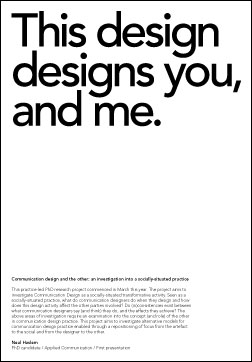
<p>Communication design and the other: an investigation into a socially-situated practice</p>

<p>This practice-led PhD research project commenced in March this year. The project aims to investigate Communication Design as a socially-situated transformative activity. Seen as a socially-situated practice, what do communication designers do when they design and how does this design activity affect the other parties involved? Do (in)consistencies exist between what communication designers say (and think) they do, and the effects they achieve? The above areas of investigation require an examination into the concept (and role) of the other in communication design practice. This project aims to investigate alternative models for communication design practice enabled through a repositioning of focus from the artefact to the social and from the designer to the other.</p>

<p>The Poster</p>

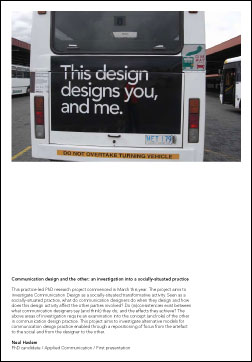
<p>Miek is in charge of uploading the posters for New Views 2. He saw the poster I uploaded for NV2 and said he liked it. It was the 'This design designs you, and me.' poster. The one with the black text on a portrait format white background. I showed him the photo of the busback I was sent from Hobart (the bus,with poster, is going around Hobart city now). Miek said maybe I should have used that one for the poster. I wondered about that. </p>

<p>For this GRC I tried taking his advice and using the busback photo - however when I put it together I thought it read as though it was a documentation of a project. At this stage in my PhD I would rather the GRC poster (and event) read as an 'investigation' than a 'documentation'  - so I went back to the black on white background text version with the addition of my abstract and title.</p>

<p><img alt="poster_01-1.jpg" src="http://www.nealhaslem.net/archives/poster_01-1.jpg" width="252" height="362" /></p>

<p><img alt="poster_01-2.jpg" src="http://www.nealhaslem.net/archives/poster_01-2.jpg" width="252" height="362" /></p>]]>
        
    </content>
</entry>
<entry>
    <title>Bus Back</title>
    <link rel="alternate" type="text/html" href="http://www.nealhaslem.net/archives/2008/05/bus_back.html" />
    <link rel="service.edit" type="application/atom+xml" href="http://www.decomm.net/movabletype/mt-atom.cgi/weblog/blog_id=9/entry_id=857" title="Bus Back" />
    <id>tag:www.nealhaslem.net,2008://9.857</id>
    
    <published>2008-05-12T03:27:05Z</published>
    <updated>2008-05-13T13:57:07Z</updated>
    
    <summary>I designed a bus back as part of an AGDA Tasmania project. The brief was: - promote the bus as green - promote ads on buses - promote graphic design in Tasmania I was pretty excited by what I had...</summary>
    <author>
        <name>Neal Haslem</name>
        
    </author>
            <category term="projects" />
    
    <content type="html" xml:lang="en" xml:base="http://www.nealhaslem.net/">
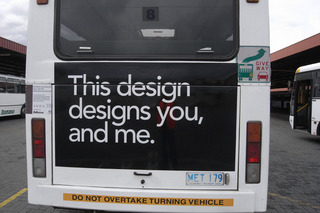
        <![CDATA[<p>I designed a bus back as part of an AGDA Tasmania project.</p>

<p><a href="http://www.nealhaslem.net/archives/080501_busback.html" onclick="window.open('http://www.nealhaslem.net/archives/080501_busback.html','popup','width=850,height=567,scrollbars=no,resizable=no,toolbar=no,directories=no,location=no,menubar=no,status=no,left=0,top=0'); return false"><img src="http://www.nealhaslem.net/archives/080501_busback-thumb.jpg" width="320" height="213" alt="" /></a></p>

<p>The brief was:<br />
- promote the bus as green<br />
- promote ads on buses<br />
- promote graphic design in Tasmania</p>

<p>I was pretty excited by what I had seen going on in Sao Paolo <a href ="http://www.adbusters.org/the_magazine/73/So_Paulo_A_City_Without_Ads.html" target="_blank"> So_Paulo_A_City_Without_Ads.html</a> and I was thinking about setting up websites or doing things with schoolkids...</p>

<p>In the end it had to be done, and the AGDA rep said it was to promote ads on buses so perhaps an anti-ad wasn't appropriate...</p>

<p>I've also sent it in as a research poster for New Views 2... it's a research poster that does the research...(a provocation?)</p>]]>
        
    </content>
</entry>
<entry>
    <title>New Dawkins show</title>
    <link rel="alternate" type="text/html" href="http://www.nealhaslem.net/archives/2008/05/new_dawkins_show.html" />
    <link rel="service.edit" type="application/atom+xml" href="http://www.decomm.net/movabletype/mt-atom.cgi/weblog/blog_id=9/entry_id=856" title="New Dawkins show" />
    <id>tag:www.nealhaslem.net,2008://9.856</id>
    
    <published>2008-05-12T03:20:22Z</published>
    <updated>2008-05-13T13:58:13Z</updated>
    
    <summary>Richard Dawkins has made a new show called Enemies of Reason. The second issue was aired on ABC Compass religious show last night. I discussed it briefly with Laurene (my supervisor) this morning. He is attacking the alternative, mystical, metaphysical...</summary>
    <author>
        <name>Neal Haslem</name>
        
    </author>
    
    <content type="html" xml:lang="en" xml:base="http://www.nealhaslem.net/">
        <![CDATA[<p>Richard Dawkins has made a new show called <a href ="http://www.channel4.com/culture/microsites/E/enemies_of_reason/" target="_blank">Enemies of Reason. </a>The second issue was aired on ABC Compass religious show last night. I discussed it briefly with Laurene (my supervisor) this morning.</p>

<p>He is attacking the alternative, mystical, metaphysical and anything that could be seen as non-rational, anti-science or in the least bit fluffy. I was thinking that Design as a field is an excellent field for the  debate of these ideas to take place. Dawkins comes from a strict positivist modality, and design is a place where the positivist and metaphysical meet head-on and the debate still goes on strong, particularly in the design research area as we discuss 'what is (valid) research?'</p>

<p>Dawkins is, as Laurene remarks, a fundamentalist for the 'church of science'. A zealot, you wonder how he might deal with the unknown...</p>

<p>Dawkins knows what research is; 'show me your double-blind repeatable experiments!'... 'where's your control?'... as we now know, his positivist stance doesn't reveal all that design has to offer, so where do we go? Into practice-led research? and how do we find common ground with this discourse, or is it in design that a common ground, and a space for discussion, exists...</p>]]>
        
    </content>
</entry>
<entry>
    <title>new philosophy...</title>
    <link rel="alternate" type="text/html" href="http://www.nealhaslem.net/archives/2008/04/new_philosophy.html" />
    <link rel="service.edit" type="application/atom+xml" href="http://www.decomm.net/movabletype/mt-atom.cgi/weblog/blog_id=9/entry_id=855" title="new philosophy..." />
    <id>tag:www.nealhaslem.net,2008://9.855</id>
    
    <published>2008-04-25T03:27:41Z</published>
    <updated>2008-04-25T03:41:46Z</updated>
    
    <summary>and of course it is easy to get lost in this stuff Roy Bhasker and his Realist theory of science... this is interesting because it is a humanist philosophy that sits between the modernist positivist project and post-modernities relativism...the way...</summary>
    <author>
        <name>Neal Haslem</name>
        
    </author>
            <category term="critical texts" />
    
    <content type="html" xml:lang="en" xml:base="http://www.nealhaslem.net/">
        <![CDATA[<p>and of course it is easy to get lost in this stuff</p>

<p>Roy Bhasker<br />
and his Realist theory of science...<br />
this is interesting because it is a humanist philosophy that sits between the modernist positivist project and post-modernities relativism...the way he puts forward the reality of the existence of structures which are independent of our own experience while at the same time not having to rely on experimental logic to fundamentally prove them.. he talks about the 'tendencies of systems' in this way his philosophy has a lot to offer a humanist design project.</p>

<p>also<br />
Gunnar Olsson<br />
 and his new 'Critique of Cartographic Reason'... which  connects to </p>

<p>John Carroll<br />
The Wreck of Western Culture</p>

<p>this connection to the fundamental structures and valuing systems has implications from design education through to 'ethics of social space' questions...</p>

<p>but in a slightly less dramatic tone.</p>]]>
        
    </content>
</entry>
<entry>
    <title>writers on the dialectic</title>
    <link rel="alternate" type="text/html" href="http://www.nealhaslem.net/archives/2008/04/writers_on_the_dialectic.html" />
    <link rel="service.edit" type="application/atom+xml" href="http://www.decomm.net/movabletype/mt-atom.cgi/weblog/blog_id=9/entry_id=854" title="writers on the dialectic" />
    <id>tag:www.nealhaslem.net,2008://9.854</id>
    
    <published>2008-04-16T09:54:00Z</published>
    <updated>2008-04-16T10:56:19Z</updated>
    
    <summary>so then from Glanville and Law, I have moved on to Karl Popper and the way he describes &apos;conjectures and refutations&apos; as a theory for how scientific knowledge is generated... and I recently read, ummm, Nigel Cross I think it...</summary>
    <author>
        <name>Neal Haslem</name>
        
    </author>
            <category term="critical texts" />
    
    <content type="html" xml:lang="en" xml:base="http://www.nealhaslem.net/">
        <![CDATA[<p>so then from Glanville and Law, I have moved on to </p>

<p>Karl Popper<br />
and the way he describes 'conjectures and refutations' as a theory for how scientific knowledge is generated... and I recently read, ummm, Nigel Cross I think it was talking about how C and R could be seen as how design is developed...</p>

<p>now I'm not sure about this but it is worth looking into Popper, his name keeps cropping up, and looking into his theories and how they might apply to design because he did apply them himself far more widely than just into science...</p>

<p>Popper also said 'we must remember to learn from our mistakes' and this strikes home to me... from early experience and from the 'failures' paper I presented at Izmir...</p>

<p>I also need to have another look at</p>

<p>Terry Rosenberg</p>

<p>and his work on knowledge and what it is possible to know or not know....</p>

<p>and </p>

<p>Richard Saul Wurman</p>

<p>and his Information Anxiety book and writings is important too.. in as much to say how much information we have and what we have, and how we access it, and who owns it, is importnat...</p>

<p>and then there's </p>

<p>Jacques Lacan</p>

<p>and his work which built on top of Freuds, and talks about systems to analyses Self and Other etc...</p>]]>
        
    </content>
</entry>
<entry>
    <title>what do I want to know?</title>
    <link rel="alternate" type="text/html" href="http://www.nealhaslem.net/archives/2008/04/what_do_i_want_to_know.html" />
    <link rel="service.edit" type="application/atom+xml" href="http://www.decomm.net/movabletype/mt-atom.cgi/weblog/blog_id=9/entry_id=853" title="what do I want to know?" />
    <id>tag:www.nealhaslem.net,2008://9.853</id>
    
    <published>2008-04-15T09:02:52Z</published>
    <updated>2008-04-15T09:05:56Z</updated>
    
    <summary>my PhD research in 10 minutes I think I need to go away for a week somewhere and work on this what do I want to know? I want to know what communication designers do I want to know what...</summary>
    <author>
        <name>Neal Haslem</name>
        
    </author>
            <category term="proposal development" />
    
    <content type="html" xml:lang="en" xml:base="http://www.nealhaslem.net/">
        <![CDATA[<p>my PhD research in 10 minutes</p>

<p>I think I need to go away for a week somewhere and work on this</p>

<p>what do I want to know?</p>

<p>I want to know what communication designers do<br />
I want to know what happens in the act of communication design, what role the active parties take and what they do</p>

<p>why</p>

<p>because I believe that communication designers don't know what they do<br />
 <br />
why</p>

<p>because of the work I did in my Masters. </p>

<p>This work showed that I often wasn't aware of what I was doing when I did the work I did. </p>

<p>also when I read (currently) writing by designers about what they do it seems to always be about particular aspects of design that do exist but are only part of what cd's do.</p>

<p>This writing I keep reading seems to say that design is about a refinement of things, that it is about how to make a good thing or how to make a better thing</p>

<p>when I could say that CD seems to me to about, on one level:</p>

<p>- making cool things<br />
- making things that are legible<br />
- making things that fit their target audiences style (and help define that style)<br />
- making things that communicate the correct ideological/philosophical/social pitch<br />
- making things look 'correct' (so that the recipe book looks like a recipe book, the death metal album doesn't)<br />
- making things that are comprehendible<br />
- making things that are noticed and noticeable<br />
- making things that surprise and delight, so give their viewers/readers/users a valuable experience<br />
- making things that please the commissioning agent</p>

<p>but about on another level:</p>

<p>- defining cultures<br />
- expressing cultures<br />
- expressing that which cannot be expressed verbally or through other means<br />
- generating material form for nascent cultural tendencies/movements, and in such a way to discover what those tendencies/movements are<br />
- creating a means of expression for a part of society<br />
- engaging in societies conversation<br />
- expressing ideologies<br />
- finding personal 'truths'<br />
- finding Identity<br />
- focusing Identity<br />
- exploring Identity and roles within a community<br />
- allowing voices to emerge<br />
- accessing knowledge we have about ourselves that we don't know we have<br />
- showing us who we are</p>

<p>there is something here about 'material therapy'; sometimes CD can act to open the window a little bit, to reveal a little more of the iceberg beneath, to open up a little truth, or to provoke a little self-knowledge..</p>

<p>and it is leading through to the subject/other discussion and that paper I found about gameplay and how kids work and what they use their toys for.....</p>

<p>case-study: the website for megara; this allowed that company to communicate with itself, using me as a sounding board (punch-bag)<br />
case-study: Gold and Silversmithing ad, they don't know what they are, and then together we do know what they are... so we are finding their character... and as the designer I am part of that<br />
case-study: War is over - I find out what I feel through design...</p>

<p> </p>]]>
        
    </content>
</entry>
<entry>
    <title>another wobbly dart...</title>
    <link rel="alternate" type="text/html" href="http://www.nealhaslem.net/archives/2008/04/another_dart.html" />
    <link rel="service.edit" type="application/atom+xml" href="http://www.decomm.net/movabletype/mt-atom.cgi/weblog/blog_id=9/entry_id=852" title="another wobbly dart..." />
    <id>tag:www.nealhaslem.net,2008://9.852</id>
    
    <published>2008-04-14T11:04:16Z</published>
    <updated>2008-04-14T11:25:42Z</updated>
    
    <summary>I want to describe an alternative view of what we, as designers, do. I want to describe a transformative activity, a focused activity, which occurs when designers work with other parties to achieve outcomes. I think that this might be...</summary>
    <author>
        <name>Neal Haslem</name>
        
    </author>
            <category term="proposal development" />
    
    <content type="html" xml:lang="en" xml:base="http://www.nealhaslem.net/">
        <![CDATA[<p>I want to describe an alternative view of what we, as designers, do. </p>

<p>I want to describe a transformative activity, a focused activity, which occurs when designers work with other parties to achieve outcomes. I think that this might be a different way to describe this activity... which may then lead to a different way to value the activity of design, and teach the activity of design.</p>

<p>Here goes...</p>

<p>When designer and "others" get together to work on a project something happens. I have described this previously as 'a conversation'. In saying that I am trying to say that the outcome of the design activity is a 'made conversation' or a 'conversation materialised'. What I mean by this is that the parties present in the design activity and active in the intention of the activity, the motivation of the activity and all the different experiences and personalities present and active in the activity are in some way 'speaking'. And as the transformative action of the designing activity unrolls they are 'speaking' out the new form. 'Speaking' that which was not already in existence. 'Bringing into being'... and in that 'bringing into being' they materialise that which was not said before, and they articulate 'that which cannot be said through spoken language' in this way design allows access to 'knowledge' 'knowledge' that we don't know we know. 'knowledge' that is ineffable and cannot be articulated in other ways... design allows an articulation of this knowledge, through its connection with 'externalising of the internal', it brings into being a group reflexive device which we can all gaze into and say 'so that is what we are'.</p>

<p>art does this through the activity of the one and is, in this way, somewhat of a monologue, though it too is ineffable (this, as you might have gathered, is my new word)....</p>

<p>design is with the other...</p>]]>
        
    </content>
</entry>
<entry>
    <title>what this research is about...</title>
    <link rel="alternate" type="text/html" href="http://www.nealhaslem.net/archives/2008/04/what_this_research_is_about.html" />
    <link rel="service.edit" type="application/atom+xml" href="http://www.decomm.net/movabletype/mt-atom.cgi/weblog/blog_id=9/entry_id=851" title="what this research is about..." />
    <id>tag:www.nealhaslem.net,2008://9.851</id>
    
    <published>2008-04-14T10:34:01Z</published>
    <updated>2008-04-14T11:00:09Z</updated>
    
    <summary>I added a string of items, keywords, to the header for this blog in the hope that they would start to define to others, and myself, where my research was heading. Note that this blog is as much, if not...</summary>
    <author>
        <name>Neal Haslem</name>
        
    </author>
            <category term="proposal development" />
    
    <content type="html" xml:lang="en" xml:base="http://www.nealhaslem.net/">
        <![CDATA[<p>I added a string of items, keywords, to the header for this blog in the hope that they would start to define to others, and myself, where my research was heading. </p>

<p>Note that this blog is as much, if not more, for me than for the other. I am aware that it will be important down the line to publish my research and having the blog as an outlet for that work will become more important too. For now, however it is more a reflective tool. I still keep notebooks which anything can go into, this blog is, believe it or not, a refinement of the material which goes into those notebooks.</p>

<p>With this doctoral research I want to investigate an idea which came out of my Masters research. That idea is that..</p>

<p><b>as communication designers, we don't know what we do. </b></p>

<p>Now this is a very provocative, loose and easily attacked statement, but I want to hold it for a while... because I cannot actually articulate what my research is about and I can only, at this moment, make statements which sort-of 'chuck darts' at that idea... after a bit of dart throwing a picture begins to emerge. So, once again, be warned, this blog is very much 'research in progress' it is a working tool to hold some of these ideas up to the light and see what happens... in that way this blog, and this research, is design (see Glanville for design as research)</p>

<p>so the idea is</p>

<p>if we view the transformative activity of communication design as a social practice, and we view it as an activity in which all parties are focused on some manifold aspect/view/issue/ambition/desire, then the act that transpires is not 'known'. That act is not described in the current theoretical design canon. (Well it is hardly described, it is not a dominant 'model' for practice, it is a slippery sometimes assumed, sometimes disregarded, often ignored model for practice. However, for me, it seems like one of the most important, and it seems that it has important abilities to allow the development of a more socially sustainable form of communication design practice.) That act that occurs, the event of design, can be seen as a creative act from an insightful individual... I would like to take some alternative theories which might, if applied to this act, describe it as a transformative process whereby knowledge we don't know we already have is revealed through the transformative and enabling activity of engaging with a technology (writing, talking, making) which through it agency allows us to disarm our rational 'I know' selves and welcome in the unsaid, unborn, unmade other into the known world. </p>

<p>Now I hope this doesn't sound like summoning, but I know that it does. So; alchemy, witchcraft, magic, access to power, tapping into the unconscious, archetypal knowledge, implicity knowledge, the rift between natural human and artificial human, the cyborg... all these aspects are there, and, as such, it is a direct contradiction to the 'design as science' methodology a lot of communication deisgners long for.<br />
</p>]]>
        
    </content>
</entry>

</feed>